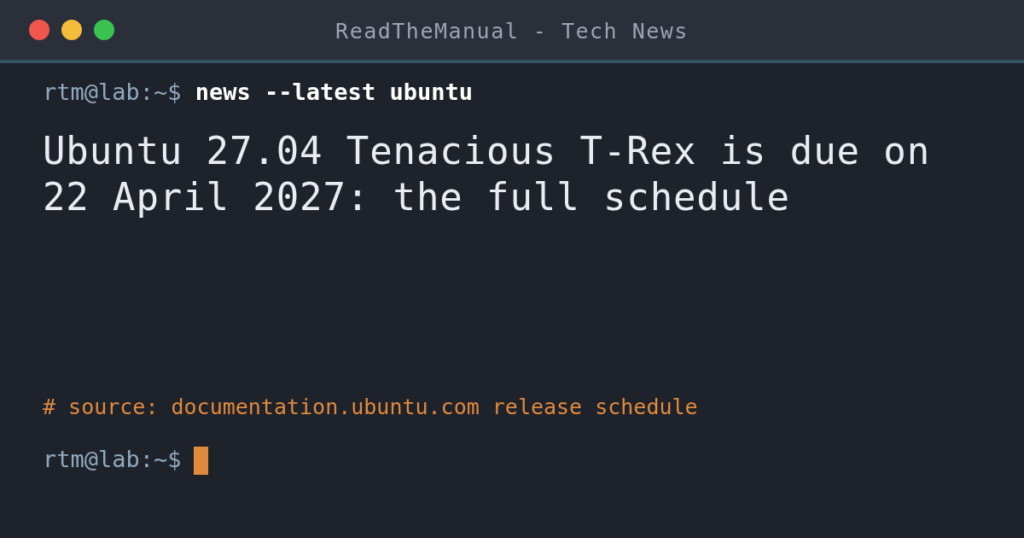
Ubuntu 27.04 Tenacious T-Rex is due on 22 April 2027, with the beta on 1 April, and it will get only nine months of updates, until January 2028. For a homelab that settles the question: keep servers on 26.04 LTS, supported to May 2031, and run 27.04 only on a desktop or test VM you are happy to upgrade again within the year.
Last updated 16 October 2026. Sources are linked in the text and listed at the end.
What changed
Canonical has published the official Tenacious T-Rex release schedule. Schedules used to live on Ubuntu Discourse; the Discourse schedule topics now point to the release notes site, which is where this one sits. Development opens on 22 October 2026 with the toolchain upload, based on Ubuntu 26.10 Stonking Stingray, which shipped on 15 October.
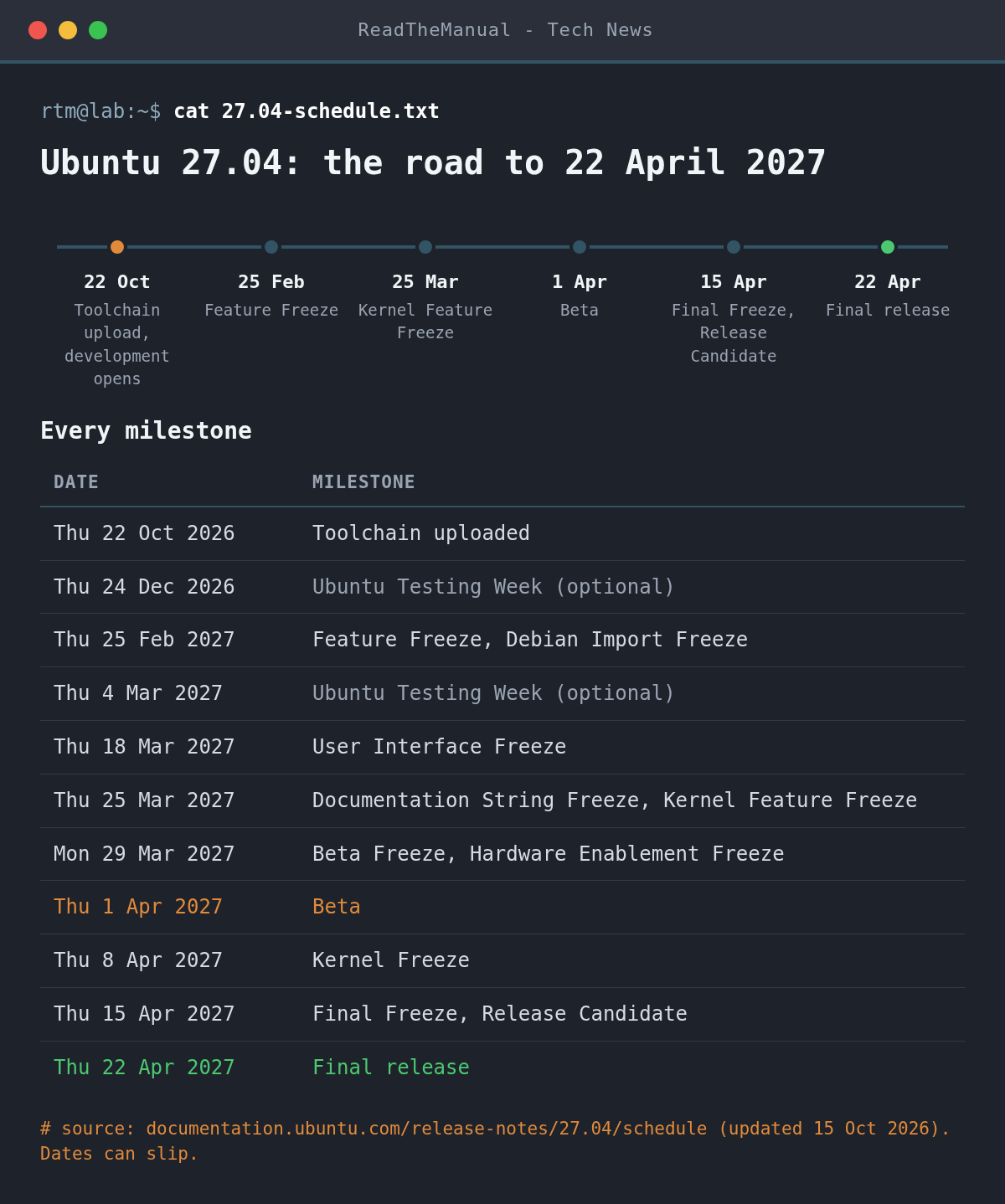
The key dates, all 2027 unless noted:
- 22 October 2026: toolchain uploaded, development opens
- 24 December 2026 and 4 March: optional Ubuntu Testing Weeks, which replace the old alpha milestones
- 25 February: Feature Freeze and Debian Import Freeze
- 18 March: User Interface Freeze
- 25 March: Kernel Feature Freeze
- 1 April: Beta
- 8 April: Kernel Freeze
- 15 April: Final Freeze and Release Candidate
- 22 April: final release
Two dates in early coverage need correcting against the official table. Monday 29 March is the Beta Freeze; the beta itself is Thursday 1 April. And 25 March is the Kernel Feature Freeze, not the Kernel Freeze, which follows on 8 April.
Features are thin on the ground this early. 9to5Linux expects GNOME 52, which is due on 17 March 2027, and notes it will be the 46th Ubuntu release. OMG! Ubuntu adds that a Rust-based time sync server, ntpd-rs, could land if the work is ready, which fits the Rust push that took coreutils fully to Rust in 26.10. The codename’s first word is also the repository name, so your sources will say tenacious, and the version number is a target date that can slip.
What it means for your homelab
The support maths decides this. Per Canonical’s release cycle page, interim releases get nine months of updates, while 26.04 LTS gets standard security maintenance to May 2031. Ubuntu Pro, free for personal use on up to five machines, stretches that to May 2036.
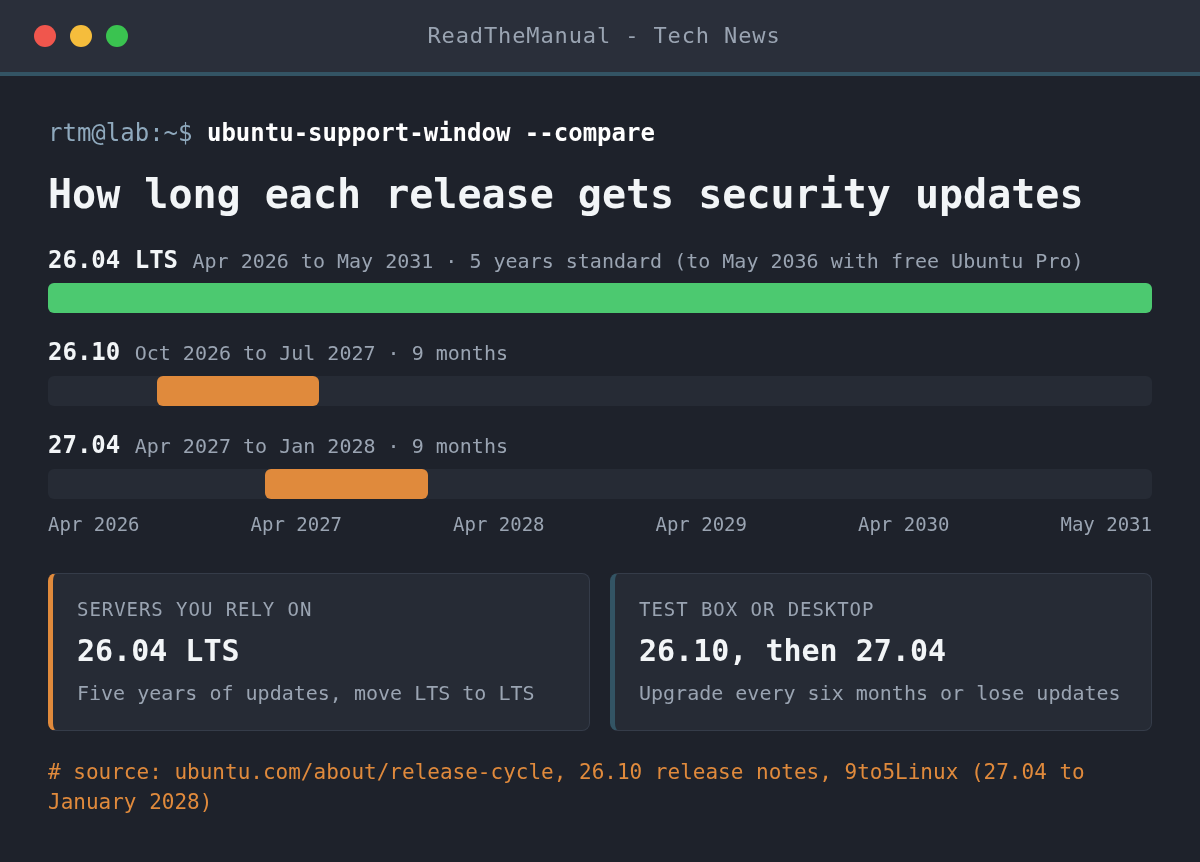
Interim releases chain together. You cannot jump from 26.04 straight to 27.04: the path is 26.04 to 26.10 to 27.04, and each step is a full release upgrade. 26.10 support ends in July 2027, three months after 27.04 arrives, so anyone on the interim track does a release upgrade every six months or falls off security updates. On a Docker host or a DNS server that runs unattended-upgrades and is otherwise left alone, that is the wrong trade.
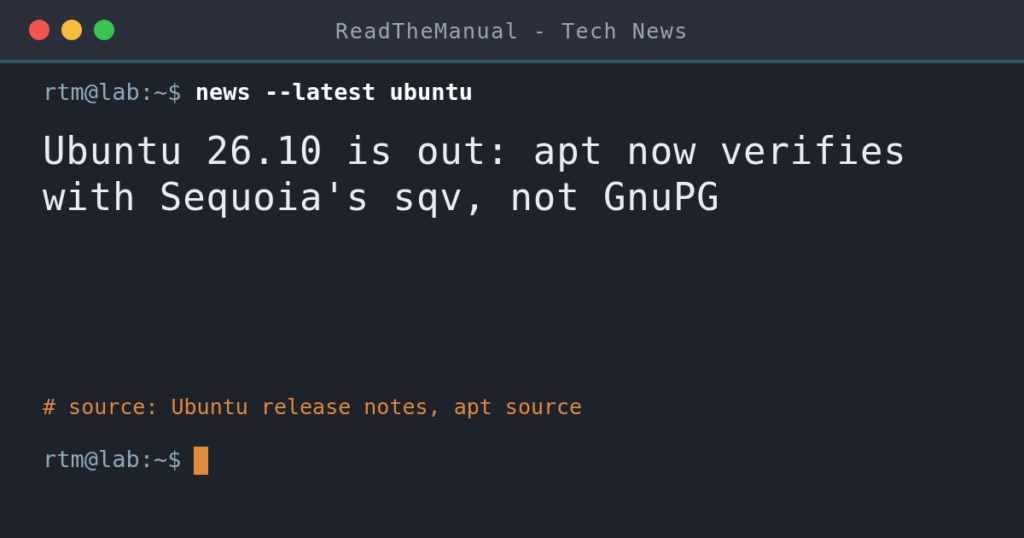
27.04 makes sense on a daily-driver desktop where you want GNOME 52 and newer packages, or on a test VM where you rehearse what the next LTS will change. Newer hardware is rarely a reason to leave LTS, since LTS point releases pick up newer kernels through the hardware enablement (HWE) stack. The bigger value of interims for a homelab is the preview: changes like 26.10’s switch of apt signature checks to Sequoia’s sqv land in an interim first and reach the next LTS later.
How to check what you run
Check the release, and whether the machine is set to be offered interim upgrades. Prompt=lts means LTS-to-LTS only, Prompt=normal means every release:
grep -E '^(VERSION|VERSION_CODENAME)=' /etc/os-release
grep '^Prompt' /etc/update-manager/release-upgrades
For servers, keep it on lts. A test VM on 26.10 that should follow the interim track needs normal (a fresh 26.10 install usually has it already); run the upgrade once 27.04 is out:
sudo sed -i 's/^Prompt=.*/Prompt=normal/' /etc/update-manager/release-upgrades
sudo do-release-upgrade
Want the beta in April? Use a fresh VM from the beta image rather than upgrading a machine you depend on, and take a snapshot first. Before any release upgrade, back up /etc and your Compose files, and list the third-party repos with ls /etc/apt/sources.list.d/, because those are what usually break on a new release. Our apt package management guide covers the repo and key layout to check.
Career Context: Lifecycle questions come up in every sysadmin interview: what in your estate is near end of life, how do you know, and when do you upgrade it. Build a one-page register for your lab with host, OS release, end-of-support date and upgrade plan, and put 26.10’s July 2027 and 27.04’s January 2028 on it. That register is the same artefact a change advisory board asks for, and it shows you plan upgrades instead of reacting to them.
Sources
- Ubuntu Tenacious T-Rex Release Schedule (Canonical)
- Ubuntu release schedules moved to the release notes (Ubuntu Discourse)
- Ubuntu release cycle (Canonical)
- Ubuntu 26.10 release notes (Canonical)
- Ubuntu 27.04 “Tenacious T-Rex” Is Slated for Release on April 22nd, 2027 (9to5Linux)
- Ubuntu 27.04 codename revealed as ‘Tenacious T-Rex’ (OMG! Ubuntu)

ReadTheManual is run, written and curated by Eric Lonsdale.
Eric has over 20 years of professional experience in IT infrastructure, cloud architecture, and cybersecurity, but started with PCs long before that.
He built his first machine from parts bought off tables at the local college campus, hoping they worked. He learned on BBC Micros and Atari units in the early 90s, and has built almost every PC he’s used between 1995 and now.
From helpdesk to infrastructure architect, Eric has worked across enterprise datacentres, Azure environments, and security operations. He’s managed teams, trained engineers, and spent two decades solving the problems this site teaches you to solve.
ReadTheManual exists because Eric believes the best way to learn IT is to build things, break things, and actually read the manual. Every guide on this site runs on infrastructure he owns and maintains.
Enjoyed this guide?
New articles on Linux, homelab, cloud, and automation every 2 days. No spam, unsubscribe anytime.