Linux Package Management Guide for Beginners
The Gateway to Linux Administration
Every piece of software on your Linux server got there somehow. In the Debian/Ubuntu world, that somehow is apt.
Installing packages seems simple until you’re maintaining a production server at 3 AM and an update just broke everything. Understanding apt properly means knowing how to install software, yes, but also how to hold back problematic updates, roll back changes, and keep systems secure without causing outages.
This is day-one knowledge for any Linux role, but the difference between “I can run apt install” and “I manage package lifecycles in production” is worth £10-15k in salary.
Package management is something you’ll do on every Debian and Ubuntu system you touch. I manage packages across my homelab hosts, Raspberry Pis, and cloud VMs. Getting comfortable with apt means you can install, update, and troubleshoot software quickly on any Debian-based system.
apt vs apt-get: Which to Use?
Short answer: use apt for interactive work, apt-get for scripts.
| Command | Use Case | Why |
|---|---|---|
apt |
Interactive terminal | Progress bars, colour, user-friendly |
apt-get |
Scripts, automation | Stable output format, backwards compatible |
In interviews and daily work, just say apt. If someone asks you about apt-get, explain that apt is the modern frontend with the same underlying functionality.
The Core Commands
Updating Package Lists
# Refresh the list of available packages
sudo apt update
This doesn’t install anything—it just fetches the latest package information from repositories. Run this before installing or upgrading to ensure you’re getting current versions.
Common mistake: Running apt install package without updating first. You might install an outdated version with known vulnerabilities.
Practitioner tip: Always run apt update before apt install. Without it, you might install an older cached version of a package, or get “package not found” errors for packages that definitely exist. I’ve seen this confuse people more times than I can count.
Installing Packages
# Install a single package
sudo apt install nginx

# Install multiple packages
sudo apt install nginx postgresql redis

# Install without prompting (for scripts)
sudo apt install -y nginx

# Install a specific version (copy the version string exactly as
# apt policy nginx lists it for your release)
sudo apt install nginx=VERSION
Upgrading Packages
# Upgrade installed packages (safe)
sudo apt upgrade

# Upgrade with smarter dependency handling
sudo apt full-upgrade

# Upgrade a specific package
sudo apt install --only-upgrade nginx
The difference: apt upgrade will install new packages if an upgrade needs them but never removes installed packages (the older apt-get upgrade does neither). full-upgrade will also remove packages if that is needed to resolve dependencies. On production, upgrade is safer; use full-upgrade when upgrade leaves packages held back, and read its removal list first. Moving to a new Ubuntu release is a separate job for do-release-upgrade.
Removing Packages
# Remove package (keep config files)
sudo apt remove nginx

# Remove package and config files
sudo apt purge nginx

# Remove unused dependencies
sudo apt autoremove

# Clean up downloaded package files
sudo apt clean
Pro tip: Use purge when you’re completely done with software. Using remove leaves config files behind, which is useful if you might reinstall later.
Searching and Information
# Search for packages
apt search nginx

# Show package details
apt show nginx

# List installed packages
apt list --installed

# List upgradable packages
apt list --upgradable

# Check if a package is installed
dpkg -l | grep nginx
Before installing anything in production, run apt show package to check dependencies and what you’re actually getting.
Managing Repositories
Understanding Sources
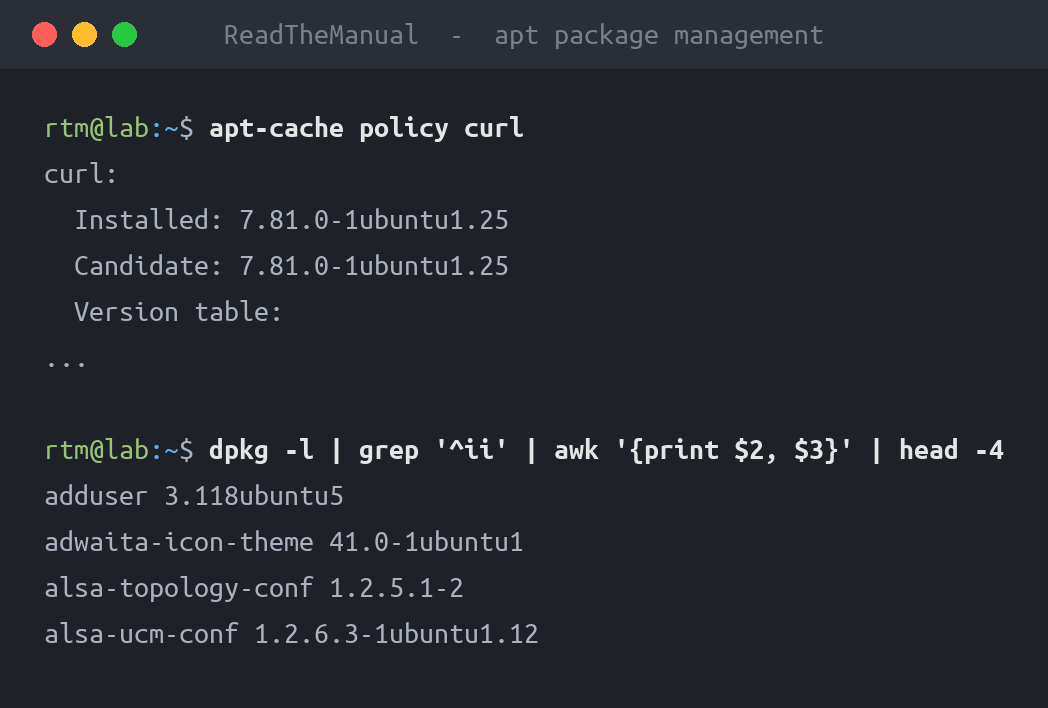
Packages come from repositories defined in /etc/apt/sources.list and files in /etc/apt/sources.list.d/. Since Ubuntu 24.04 (and on 26.04) the Ubuntu archives themselves are defined in the newer deb822 format in /etc/apt/sources.list.d/ubuntu.sources, and /etc/apt/sources.list holds little more than a comment pointing there. The default Ubuntu/Debian repos cover most needs, but sometimes you need third-party sources.
# View the Ubuntu sources (24.04 and later, deb822 format)
cat /etc/apt/sources.list.d/ubuntu.sources

# View the classic file (22.04 and earlier keep the Ubuntu archives here)
cat /etc/apt/sources.list

# List additional sources (.list = one-line format, .sources = deb822)
ls /etc/apt/sources.list.d/

# Show every repository apt is actually using
apt policy
Adding a PPA (Ubuntu)
# Add a PPA repository
sudo add-apt-repository ppa:ondrej/nginx
sudo apt update
sudo apt install nginx

# Remove a PPA
sudo add-apt-repository --remove ppa:ondrej/nginx
Adding Third-Party Repos
# Modern method (Docker example, as in Docker's own Ubuntu instructions)
sudo install -m 0755 -d /etc/apt/keyrings
sudo curl -fsSL https://download.docker.com/linux/ubuntu/gpg -o /etc/apt/keyrings/docker.asc
sudo chmod a+r /etc/apt/keyrings/docker.asc

sudo tee /etc/apt/sources.list.d/docker.sources <<EOF
Types: deb
URIs: https://download.docker.com/linux/ubuntu
Suites: $(. /etc/os-release && echo "${UBUNTU_CODENAME:-$VERSION_CODENAME}")
Components: stable
Architectures: $(dpkg --print-architecture)
Signed-By: /etc/apt/keyrings/docker.asc
EOF

sudo apt update
sudo apt install docker-ce
The key is stored in its own keyring and tied to this one repository with Signed-By, and the architecture comes from dpkg rather than being hard-coded, so the same commands work on amd64 and arm64.
Security note: Only add repositories you trust. Third-party repos can push any software to your system.
Production-Critical Skills
Holding Packages
Sometimes an update breaks things. Holding prevents a package from being upgraded.
# Hold a package at current version
sudo apt-mark hold nginx

# View held packages
apt-mark showhold

# Allow upgrades again
sudo apt-mark unhold nginx
Typical use: a new nginx (or any other) package changes behaviour your configuration relies on. Hold the package at the version you have until you have updated and tested your configuration, then unhold it.
Simulating Changes
# See what would happen without doing it
apt install nginx --simulate
apt upgrade --simulate

# Also written as
apt install nginx -s
Always simulate major changes before running them on production. This shows you exactly what packages will be added, removed, or upgraded.
Checking Security Updates
# List only security updates
apt list --upgradable | grep -i security

# Preview what unattended-upgrades would install (security updates by
# default on Ubuntu; it is preinstalled on Ubuntu Server)
sudo apt install unattended-upgrades
sudo unattended-upgrades --dry-run --debug
Downgrading Packages
When an update breaks things:
# Check available versions
apt policy nginx

# Install an older version (one that apt policy still lists)
sudo apt install nginx=VERSION

# Hold to prevent re-upgrading
sudo apt-mark hold nginx
Fixing Broken Dependencies
# Fix broken dependencies
sudo apt --fix-broken install

# Reconfigure packages that failed
sudo dpkg --configure -a

# Force overwrite conflicting files (last resort)
sudo apt install -o Dpkg::Options::="--force-overwrite" package
Understanding apt Output
When you run apt upgrade, understand what it’s telling you:
The following packages will be upgraded:
  nginx nginx-common
2 upgraded, 0 newly installed, 0 to remove and 0 not upgraded.
Need to get 1,234 kB of archives.
After this operation, 0 B of additional disk space will be used.
| Line | Meaning |
|---|---|
| X upgraded | Packages getting new versions |
| X newly installed | New packages being added |
| X to remove | Packages being uninstalled |
| X not upgraded | Held or dependency-blocked packages, or on Ubuntu, phased updates still being rolled out gradually |
If you see unexpected removals, stop and investigate. apt will happily remove critical packages if a dependency conflict requires it.
Automation: Unattended Upgrades
Security updates should happen automatically. Here’s the standard setup:
# Install
sudo apt install unattended-upgrades

# Enable
sudo dpkg-reconfigure -plow unattended-upgrades

# Configure what gets updated
sudo nano /etc/apt/apt.conf.d/50unattended-upgrades
Default behaviour: security updates only, applied automatically. This is safe for most production systems and ensures you’re not running vulnerable software.
Common Interview Scenarios
- “How do you update a production server?”
# 1. Check what will be upgraded
sudo apt update
apt list --upgradable

# 2. Review the changes
sudo apt upgrade --simulate

# 3. Perform the upgrade
sudo apt upgrade

# 4. Verify services still work
systemctl status nginx
Pro tip: “For major updates, I’d do this during a maintenance window, have a rollback plan, and test in staging first.”
- “A package update broke the application. What do you do?”
- Answer: “First, identify which package caused the issue from /var/log/apt/history.log. Then downgrade using apt install package=version, hold that package, and document the issue. Long-term, we’d work on compatibility and plan the upgrade properly.”
# Find what changed
cat /var/log/apt/history.log | tail -50

# Check available versions
apt policy problematic-package

# Downgrade
sudo apt install problematic-package=old.version

# Hold
sudo apt-mark hold problematic-package
- “How do you install software not in the default repos?”
- Answer: “Depends on the software. For well-maintained projects, I’d add their official repository with the GPG key. For less common software, I’d consider Docker containers for isolation. As a last resort, manual installation from source, but that creates maintenance burden.”
The Career Translation
| Skill | Role Level | Why It Matters |
|---|---|---|
| install/remove | Any Linux role | Basic software deployment |
| update/upgrade | Junior admin | System maintenance |
| hold/downgrade | Mid-level | Production incident recovery |
| repo management | Mid-level | Enterprise software deployment |
| automation | Senior/DevOps | Security and compliance |
A candidate who can explain holding packages and rollback procedures demonstrates production experience. That’s the difference between a £32k junior role and a £45k position.
Quick Reference
# Update and upgrade
sudo apt update              # Refresh package lists
sudo apt upgrade             # Upgrade installed packages
sudo apt full-upgrade        # Upgrade with dependency changes

# Install and remove
sudo apt install package     # Install
sudo apt remove package      # Remove (keep config)
sudo apt purge package       # Remove (delete config)
sudo apt autoremove          # Clean unused dependencies

# Search and info
apt search term              # Find packages
apt show package             # Package details
apt list --installed         # What's installed
apt list --upgradable        # What can be upgraded

# Version control
sudo apt-mark hold package   # Prevent upgrades
sudo apt-mark unhold package # Allow upgrades
apt policy package           # See available versions

# Troubleshooting
sudo apt --fix-broken install   # Fix dependencies
apt install package --simulate  # Preview changes
cat /var/log/apt/history.log    # Recent changes

Next Steps
Package management is foundational. Build on it with:
- Configuration management – Ansible uses apt modules extensively
- Container awareness – When to use apt vs Docker
- dnf/yum – Red Hat family uses different tools, same concepts
- Security scanning – Tools that check for vulnerable packages
Every server you touch will need packages installed, updated, and maintained. Doing this properly is what separates administrators who cause outages from those who prevent them.
Part 3 of the Linux Fundamentals series. Next: Linux file permissions—the security concept that trips up most interview candidates.
Linux Fundamentals Series – Part 3 of 12
Previous: Mastering systemctl: Service Management
RTFM Apparel · printed in the UK


ReadTheManual is run, written and curated by Eric Lonsdale.
Eric has over 20 years of professional experience in IT infrastructure, cloud architecture, and cybersecurity, but started with PCs long before that.
He built his first machine from parts bought off tables at the local college campus, hoping they worked. He learned on BBC Micros and Atari units in the early 90s, and has built almost every PC he’s used between 1995 and now.
From helpdesk to infrastructure architect, Eric has worked across enterprise datacentres, Azure environments, and security operations. He’s managed teams, trained engineers, and spent two decades solving the problems this site teaches you to solve.
ReadTheManual exists because Eric believes the best way to learn IT is to build things, break things, and actually read the manual. Every guide on this site runs on infrastructure he owns and maintains.
Enjoyed this guide?
New articles on Linux, homelab, cloud, and automation every 2 days. No spam, unsubscribe anytime.